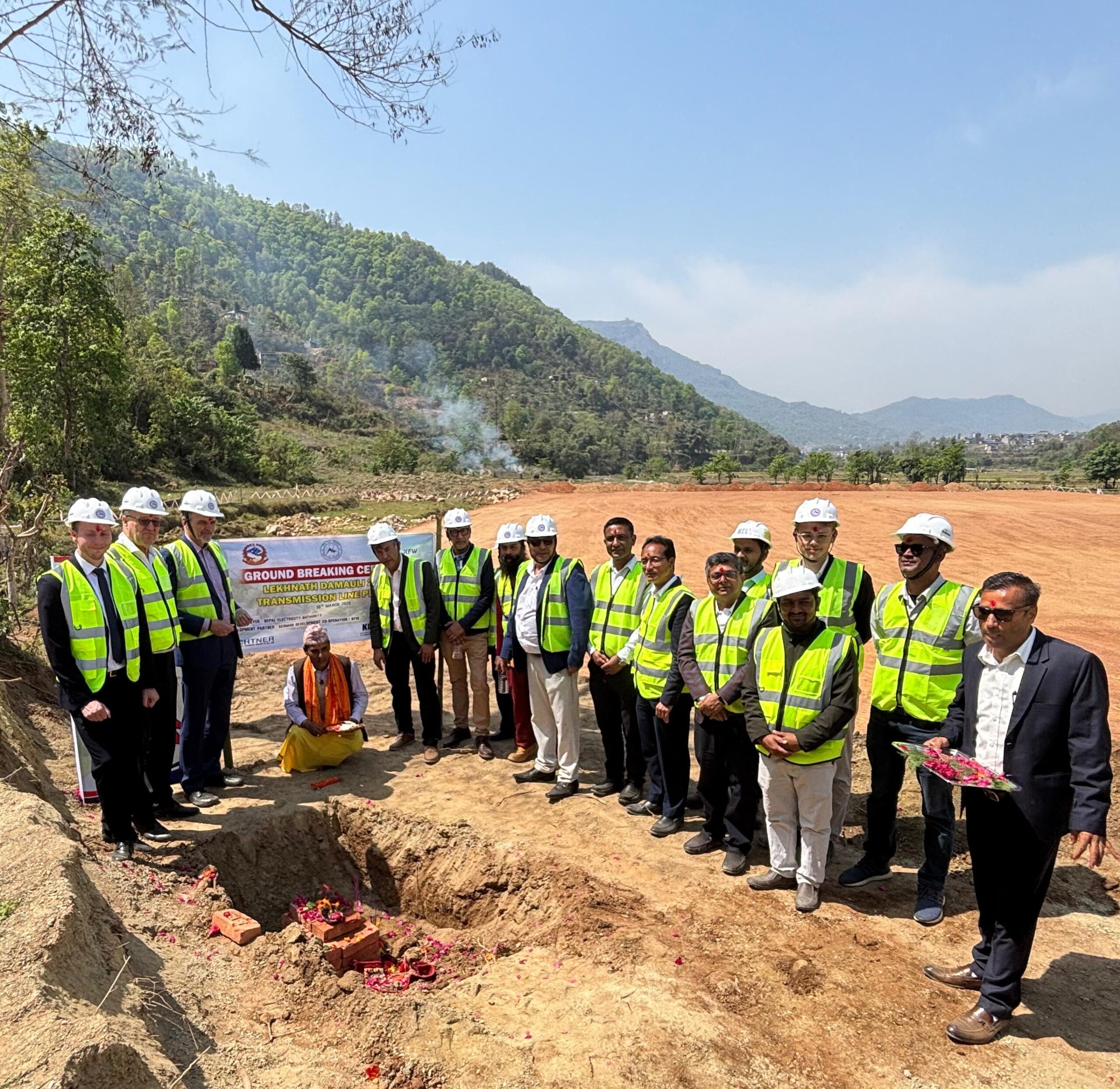
Damauli, 18 March 2026 – The Nepal Electricity Authority (NEA), in collaboration with the Government of Germany, today inaugurated the groundbreaking of the Lekhnath–Damauli 220 kV Transmission Line Project at the Damauli Substation in Tanahun District. The ceremony was attended by NEA Managing Director Hitendra Dev Shakya, German Ambassador to Nepal Udo Volz, Director of KfW Development Bank for Bangladesh and Nepal Michael Sumser, as well as senior representatives from NEA, the German Embassy, KfW, GIZ, local governments, and other stakeholders.
Co-financed by Germany through KfW Development Bank, the project involves the construction of a 45 km long 220 kV double-circuit transmission line and modern gas-insulated substations in Lekhnath and Damauli. With a transmission capacity of approximately 1,000 MW, the project will strengthen Nepal’s regional electricity grid and facilitate efficient evacuation of electricity from hydropower plants, including the Tanahun Hydropower Project. The upgraded infrastructure is expected to improve grid reliability, support renewable energy integration, and contribute to sustainable economic development and energy security.
“Expanding reliable transmission infrastructure is essential for Nepal’s growing energy needs,” said Ambassador Udo Volz. “Germany is proud to partner with Nepal to strengthen its electricity grid and harness its vast renewable energy potential. Projects like this ensure that clean energy reaches homes, businesses, and industries, fostering sustainable economic growth.”
The project highlights the long-standing energy partnership between Nepal and Germany. German Financial Cooperation has supported Nepal’s energy sector for decades, from hydropower projects such as Lower Marsyangdi and Middle Marsyangdi, to transmission infrastructure initiatives including the Chilime–Trishuli line and the National Load Dispatch Centre. Germany has also contributed to solar energy development, enabling around 55 MW of solar photovoltaic capacity in Nepal. Future cooperation will increasingly focus on strengthening power distribution to ensure reliable electricity supply across the country.
In addition to financial investments, German Technical Cooperation through GIZ supports policies, systems, and skill development to maximize the benefits of Nepal’s growing electricity infrastructure. In Gandaki Province, this includes assisting Pokhara Metropolitan City in developing a five-year Municipal Energy Plan, installing electric vehicle charging stations in Pokhara and Damauli, and integrating micro-hydropower plants in Baglung into the national grid.
Reliable transmission lines like Lekhnath–Damauli form the backbone for expanding clean electricity use, including electric mobility and other low-carbon solutions, advancing Nepal’s goal to reduce dependence on imported fossil fuels. The combined efforts of KfW and GIZ underscore Germany’s comprehensive approach to supporting Nepal’s transition toward a sustainable, climate-friendly, and reliable energy system.
