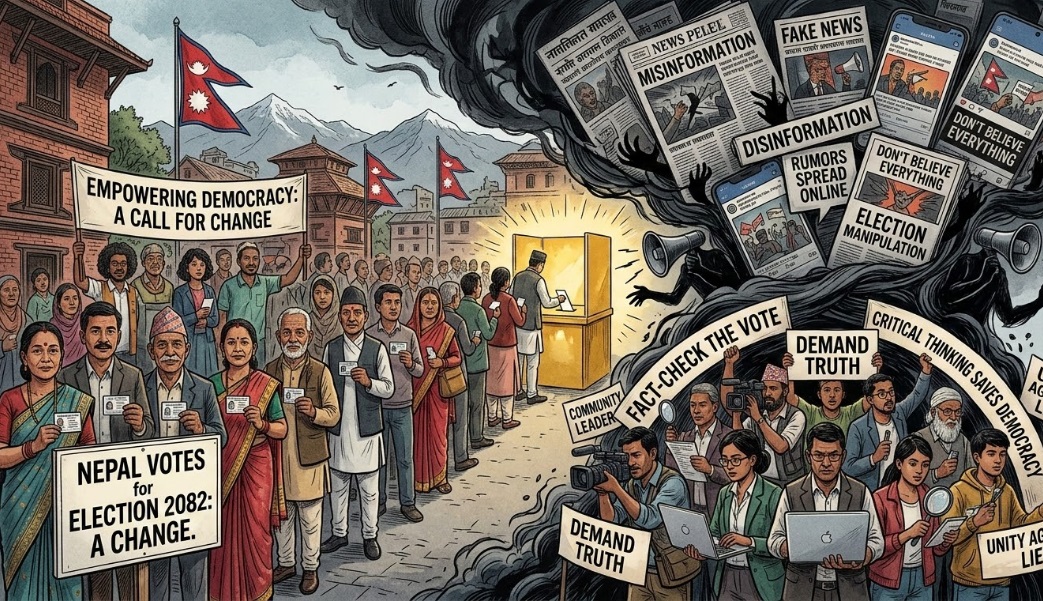
Nepal’s Election 2082 was more than just another democratic exercise. For many citizens across the country, it felt like a moment of reflection, hope, and in some ways, a quiet protest expressed through the ballot box.
With nearly 19 million registered voters, citizens across Nepal headed to polling stations to elect representatives to the 275-member House of Representatives, where 165 members are chosen through direct voting and 110 through proportional representation under the leadership of the Election Commission of Nepal. Despite logistical challenges and political tension in the months leading up to the vote, turnout remained strong at around 60 percent, reflecting the public’s continued belief in the democratic process.
This election came at a sensitive moment for the country. The political environment had been shaped by the aftermath of the 2025 Nepal Youth Protests, where thousands of young people demanded accountability, transparency, and better governance. Many of those same young citizens were seen waiting patiently in long lines outside polling stations this week, determined to turn their voices into votes.
While the election process remained largely peaceful, it was not without challenges. One of the most significant issues during the campaign period was the rapid spread of fake news, misinformation, and disinformation, particularly on social media platforms. The Election Commission of Nepal reported hundreds of online posts that violated election guidelines, ranging from manipulated images of candidates to false claims about voting procedures.
The Election Commission of Nepal identified and took action against 302 cases of misinformation, disinformation, and hate speech that violated the election code of conduct.
Case Study 1: Fake Videos and Deepfakes
AI-generated videos and manipulated images of political leaders circulated on social media platforms during the campaign period. These deepfake clips falsely portrayed candidates making controversial statements, misleading voters and creating confusion about party positions.
Case Study 2: Viral False Claims About Candidates
Several posts falsely accused candidates of corruption or foreign influence. These claims spread quickly across Facebook and TikTok before fact-checking organizations and authorities clarified that the information was fabricated.
Case Study 3: Misleading Election Rumours
Authorities also detected rumours about vote rigging and voter data leaks circulating online. The Election Commission had to issue public clarifications to prevent panic and misinformation from undermining trust in the electoral process.
In one widely circulated case, edited video clips of political leaders were shared online to suggest controversial remarks that were never actually made. These clips spread quickly across platforms before fact-checkers clarified the truth. In another instance, viral posts falsely accused several candidates of corruption or foreign influence without evidence. Such content not only confused voters but also raised concerns about the vulnerability of elections in the digital age.
Rumors about vote tampering and voter data leaks also circulated online on election day. Although these claims were later proven false, they illustrated how quickly misinformation can undermine public trust during critical democratic moments.
Yet beyond these digital battles, the human side of the election remained powerful. In rural districts, voters walked for hours to reach polling centers. In cities like Kathmandu, young voters proudly shared photos of inked fingers, celebrating their participation in shaping the nation’s future.
Nepal’s Election 2082 ultimately reflects a country at a crossroads. Citizens are eager for political renewal and better governance, but the election also highlights a growing challenge: protecting democracy from the disruptive power of misinformation.
The message from voters is clear. Nepal’s democracy is evolving, and while the road ahead may not be simple, the willingness of its people to show up, stand in line, and vote suggests that hope remains stronger than doubt.
Beyond the statistics and political drama, the election carried deep emotional significance for many citizens. For young voters who participated in last year’s protests, casting their vote was seen as a step toward building a more accountable political system.
Across villages and cities, people waited in long lines outside polling stations, some travelling hours from remote mountain areas to vote. For many, the election represented hope that the sacrifices made during the protests would lead to real change.
While the election marks a major shift in Nepal’s political landscape, analysts note that the real challenge begins after the results. The new leadership faces high public expectations to tackle corruption, improve governance, and create economic opportunities for the country’s youth.
Nepal’s Election 2082 may therefore be remembered not only as a democratic exercise, but also as a moment when citizens demanded a new direction for the nation.
