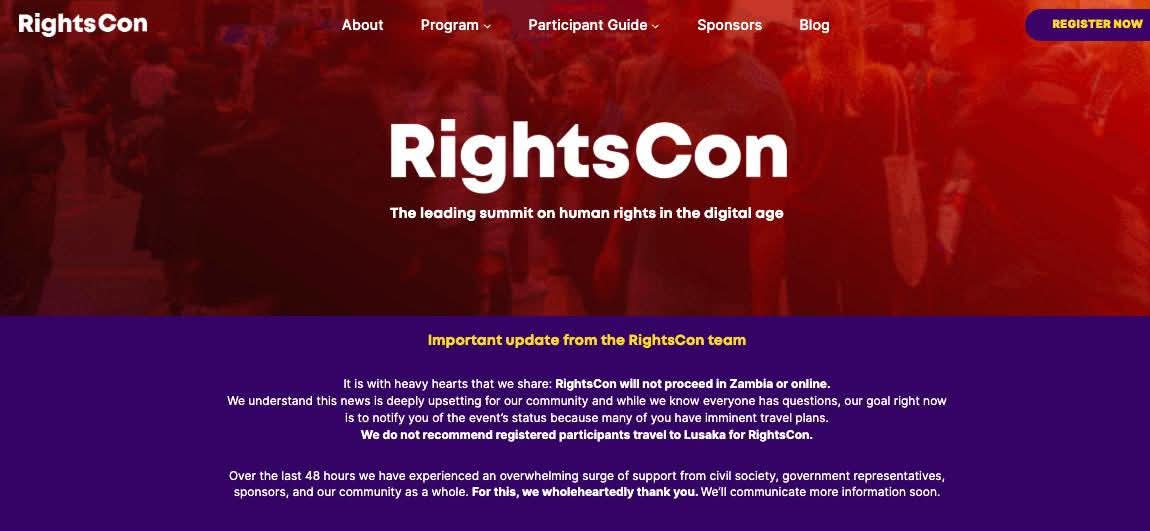
ACCESS Now the organizers of Rights Con 2026 share, It is with heavy hearts that we share: RightsCon will not proceed in Zambia or online. Those ten words, issued by digital rights organization Access Now on April 30, brought an abrupt and shocking end to one of the most anticipated gatherings in the global technology and human rights calendar.The Zambian government abruptly cancelled RightsCon 2026, the world’s largest conference on human rights in the digital age, just five days before it was set to begin in Lusaka. More than 5,000 participants from around the world were expected to attend the summit. Access Now, is one of the world’s leading gatherings on human rights in the digital age. The 2026 edition was scheduled to take place in Lusaka from 5 to 8 May. It would have been the first time the global event was hosted in Sub-Saharan Africa. Previously, it was held in San José, Tunis, Toronto, Brussels, Rio de Janeiro and Manila, among other places. Access Now had built RightsCon into the premier annual global digital rights gathering and made incredible efforts to ensure it is accessible to everyone in the global digital rights community. For the African digital rights community especially, hosting the summit on the continent was a milestone long fought for.As recently as March 2026, things appeared on track. On March 3, the Ministry of Technology and Science had welcomed the hosting of RightsCon 2026 when it met with the organizers and emphasized that the summit was consistent with Zambia’s national development agenda. It also reaffirmed the Zambian government’s commitment to collaborate with the organizers to ensure the successful hosting of the summit. According to some expected participants, the ministry had issued them official letters in February to support granting them visas to attend the conference.
The first blow came on April 28. Zambia’s government announced the postponement, saying it needed more time to ensure the conference “fully aligns with national procedures, diplomatic protocols, and the broader objective of fostering a balanced and consensus-driven platform for dialogue.” “In particular, certain invited speakers and participants remain subject to pending administrative and security clearances, which have not yet been concluded.” With just days remaining and with many participants already en route, Zambian government officials announced they would postpone the conference in order to “ensure full alignment with Zambia’s national values, policy priorities, and broader public interest considerations.” On Wednesday, after attempting to negotiate a solution, RightsCon organizers announced the event would “not proceed.” Access Now urged registered participants not to travel to Lusaka, noting an overwhelming surge of support from civil society, government representatives, sponsors, and the broader community in the preceding 48 hours. The China ConnectionWhat began as a bureaucratic-sounding postponement quickly unravelled to reveal a more troubling story. A Zambian news site published a report citing “well-placed sources” that told the outlet the summit had been cancelled because the programme involves Taiwanese delegates who would potentially speak against China at a venue donated by the Chinese government. A statement issued by the advocacy organization Article 19 noted, “We are aware of claims, many of them well-founded, that pressure from foreign governments contributed to the Zambian government’s decision.” A civil society activist involved in the RightsCon organizing committee in Lusaka told Human Rights Watch that the postponement came after the Chinese government had expressed displeasure to Zambian authorities about invited participants from Taiwan. Human Rights Watch was direct in its assessment: the Zambian government’s decision to postpone RightsCon 2026 raised concerns about the authorities’ commitment to free expression and assembly and about possible Chinese government interference. A Shrinking Civic Space and an Election LoomingThe cancellation did not happen in a vacuum. RightsCon was set to open just more than three months before Zambia’s August 13 general election. Zambia’s digital policies have drawn criticism, including a pair of new laws enacted last year that legal and human rights experts say raise significant concerns over government surveillance and repression of speech. The human rights environment in Zambia has become increasingly hostile to perceived dissent, criticism, and political opposition to the government ahead of the 2026 elections.The Net Rights Coalition and more than 130 digital rights stakeholders said the postponement and effective cancellation raised concerns about closing civic space and fostering a culture of self-censorship ahead of the August 2026 elections, and called it a major setback for Zambia’s digital rights trajectory regionally and globally. The response from the international human rights community was swift and unsparing.”This is a serious attack on civil society,” wrote David Kaye, a University of California, Irvine law professor and former UN Special Rapporteur on freedom of opinion and expression. “Thousands of people activists, academics, government officials are en route to Lusaka. To cancel at this late stage is just horrible.” ARTICLE 19 condemned the Zambian authorities’ decision to cancel, under the guise of “postponement,” the global digital rights conference. The organization stated that what is at stake is the principle that spaces for global dialogue must be open, independent, and free from political interference.
The Center for Democracy and Technology’s CEO called the cancellation a big loss for partners in Africa and an example of the shrinking civic space, censorship, and crackdown on freedom of assembly the human rights movement faces globally. “This kind of government pressure on civil society is exactly why a space like RightsCon is needed.”
The UN Special Rapporteur on the rights to freedom of peaceful assembly and association said she was “deeply concerned” by the government’s move. What Comes NextHuman Rights Watch said the cancellation underscores the need for such events to be hosted in countries where the government openly embraces debate on human rights and supports fundamental freedoms. Access Now has not yet announced a rescheduled date or alternate venue. The broader context is bleak RightsCon has faced challenges in recent years due to adverse government actions, and some participating organizations have struggled with funding cuts due to the Trump administration’s demolition of USAID and cancellation of State Department programs focused on internet freedom. For the thousands of advocates, researchers, and activists who had staked travel budgets, session proposals, and professional connections on Lusaka 2026, the cancellation is more than a logistical setback. It is a signal that the spaces built to defend digital rights are themselves now targets.
