Kathmandu — September 2026
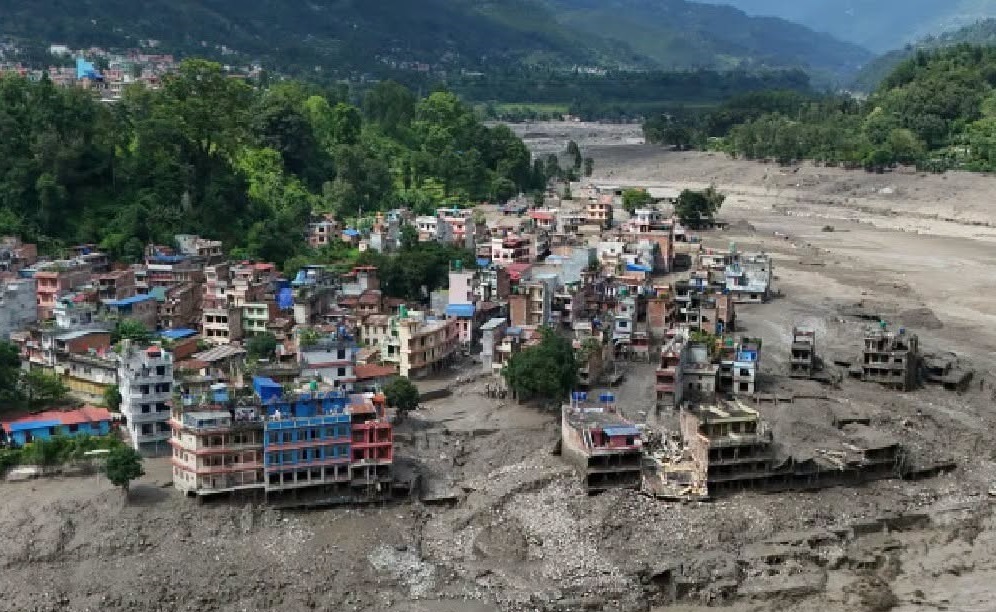
On 26 August 2026, a catastrophic flash flood tore through Nepal’s Rasuwa, Nuwakot, Dhading, Gorkha and Tanahun districts, killing more than 1,300 people according to Nepali and Chinese officials, with roughly 5,500 still missing more than a week after the disaster. The flood was triggered by the partial collapse of the glacier atop Langtang Lirung peak, sending a wall of ice, rock and debris nearly 100 km down the Lende Khola and Trishuli River valleys into Nepal and Tibet.
Roughly 7,500 homes were completely destroyed and about 20,000 more damaged. Nepal’s government estimates 84,270 people were affected across 17 municipalities in six districts, with 76% of that population already living in areas with above-average pre-flood vulnerability. Nepali authorities put the economic cost between $4 billion and $7 billion. Critical infrastructure a dozen major hydropower and transmission facilities, roads, bridges and the vital China-Nepal trade highway was wiped out or badly damaged, and an estimated 2.2 million tonnes of debris, including buildings, vegetation, rock and sediment, was mobilized.
Scientists say the disaster fits a wider pattern of destabilizing Himalayan ice. The last decade has been the warmest on record globally, accelerating snow and glacier melt, while growing populations and hydropower development push more people and infrastructure into these hazardous valleys. Experts note that a rapidly warming climate and retreating glaciers are increasing the risk of such events across the region, even where a single event’s direct cause remains debated. Some researchers suggest the glacier’s collapse may have been linked to a period of warmer-than-average temperatures destabilizing the underlying bedrock. Days after the initial collapse, a new lake that formed behind the debris also burst, compounding the flooding illustrating how thawing permafrost and melting ice are creating multiple, compounding flood hazards in high mountain regions worldwide.
Nepal is no stranger to this valley’s volatility a similar glacier collapse hit Langtang in 2015, and a glacial lake outburst flood swept away the same border bridge in July 2025. Nepal’s foreign minister called for a stronger global response to climate change, saying Nepal bears a disproportionate share of its consequences. Ironically, the long-maintained flash flood early warning system failed to detect this disaster because its water-level monitors were calibrated for monsoon floods, not glacier collapse, exposing gaps in monitoring built around the wrong hazard.
Recovery is complicated by a familiar cycle. A major dry port project at the border, worth roughly three billion rupees, was destroyed after already being damaged in 2025 with no added protection between disasters, and the access road was rebuilt within a month of the 2025 flood only to be destroyed again this year. Officials and analysts alike have questioned whether reconstruction is repeating past mistakes by rebuilding in the same exposed locations. Meanwhile, geologists caution the danger isn’t over: the remaining glacier ice, fractured bedrock and disturbed slopes above the valley may still be unstable, even as the lake that formed after the initial collapse has largely drained, easing (though not eliminating) fears of a further release.
