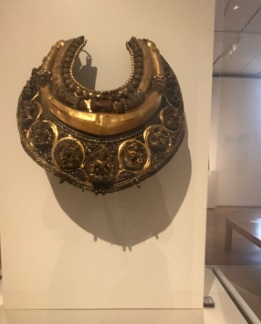
KATHMANDU — After nearly half a century in exile, a sacred 17th-century jewel-encrusted necklace belonging to Kathmandu’s matron deity Taleju Bhawani is finally set to return home.
The Art Institute of Chicago has withdrawn the historic artifact from public display and initiated formal repatriation proceedings following definitive proof that the item was stolen from Nepal in 1976. Officials from Nepal’s Department of Archaeology (DoA) expect the sacred treasure to arrive in Kathmandu within the coming months.
The sacred gilt-silver necklace embossed with semi-precious stones, pearls, and depictions of the Astamatrika (eight mother goddesses) originally adorned the idol of Taleju Bhawani, a shrine opened to the public only once a year during the Dashain festival.
- Origin: Commissioned by King Pratap Malla, who ruled Kathmandu from 1641 to 1674 CE.
- Inscriptions: Features a Sanskrit inscription praising Goddess Bhagavati and explicitly naming King Pratap Malla (
कन्थि।। श्री श्री श्री भगवती देवी जननी जयति...). - The Disappearance: In 1970, the artifact was moved from the Taleju Temple to the nearby Hanuman Dhoka Museum for security under royal army guard. Despite these measures, it was stolen in 1976.
- Reappearance: It resurfaced 45 years later in June 2021 at the Art Institute of Chicago, after being spotted and documented by Nepali scholar Dr. Sweta Gyanu Baniya.
Crucial Evidence Triggers Repatriation
The repatriation process gained momentum after US Immigration and Customs Enforcement (ICE) and the US Department of Homeland Security launched an inquiry into the item’s provenance, following outreach from Nepali diplomats and heritage activists.
“We have proved the necklace’s provenance beyond any doubt with the inventory documentation,” said Saubhagya Pradhananga, Director General of Nepal’s Department of Archaeology.
The key pieces of evidence that convinced American authorities and museum officials included:
- A 100-Year-Old Inventory: DoA submitted historical records describing a gilded necklace encrusted with pearls and Astamatrika statues, bearing King Pratap Malla’s name.
- Clarification on Ownership: Nepal confirmed that former royal family members had no legal authority to sell state antiquities, disproving claims that the item was legitimately exported through art dealers.
Before being withdrawn, museum captions indicated the piece was acquired from Bruce Miller Antiquities in California and gifted to the institute in 2010 as part of the James W. and Marilyn Alsdorf Collection.
The recovery comes amid a global movement under the 1970 UNESCO Convention to return looted antiquities to their countries of origin. Nepal has successfully reclaimed several stolen artifacts from Western institutions in recent years, including the 800-year-old Vasudhara-Laxmi-Narayan statue returned from the Dallas Museum of Art.
DoA officials stated they are actively investigating additional sacred items housed in international venues including the Musée Guimet in Paris to secure their eventual return.
